

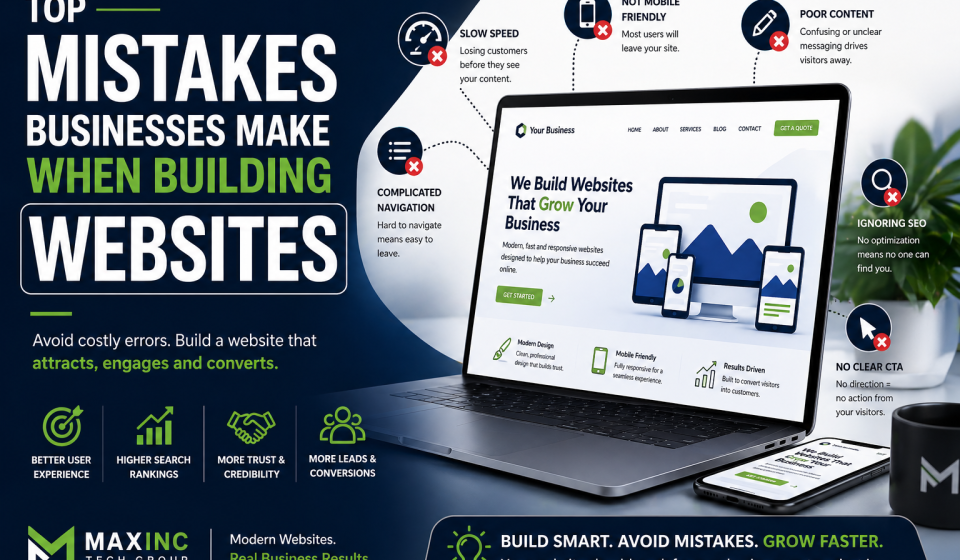

In today’s digital-first economy, a website is often the first interaction customers have with your business. Yet many small and medium-sized businesses invest in websites that fail to deliver results—not because the idea is wrong, but because of avoidable mistakes during planning, design, and execution.
If your goal is to attract customers, build trust, and generate leads, avoiding these common pitfalls can make the difference between a website that performs and one that simply exists.
1. Building Without a Clear Goal
One of the biggest mistakes businesses make is creating a website without a defined purpose.
A website should not just “look good”—it should achieve something:
- Generate leads
- Sell products
- Book appointments
- Educate customers
Without a clear goal, your website becomes confusing and ineffective.
Fix:
Define your primary objective before development. Every page, section, and feature should support that goal.
2. Poor User Experience (UX)
If visitors struggle to navigate your site, they will leave—quickly.
Common UX issues include:
- Complicated menus
- Slow loading pages
- Cluttered layouts
- Hard-to-find information
A frustrating experience directly impacts your conversion rate.
Fix:
Keep your design simple, intuitive, and user-focused. Make it easy for visitors to find what they need within seconds.
3. Ignoring Mobile Optimization
In Kenya and across Africa, the majority of users access websites via mobile devices. A desktop-only design is no longer acceptable.
Problems with non-mobile-friendly sites:
- Text is too small
- Buttons are hard to click
- Layout breaks on smaller screens
Fix:
Ensure your website is fully responsive and optimized for mobile users from the start.
4. Slow Website Speed
Speed is not just a technical issue—it’s a business issue.
A slow website:
- Drives visitors away
- Reduces search engine rankings
- Lowers conversions
Even a few seconds of delay can cost you potential customers.
Fix:
Optimize images, use reliable hosting, and minimize unnecessary plugins or heavy scripts.
5. Weak or No Call-To-Action (CTA)
Many websites fail because they don’t tell visitors what to do next.
If your site lacks direction, users will simply leave.
Examples of weak execution:
- No “Contact Us” prompt
- No clear service inquiry option
- No purchase or booking pathway
Fix:
Use clear, visible CTAs like:
- “Get a Quote”
- “Book a Consultation”
- “Start Your Project”
Guide users toward action.
6. Overloading the Website with Features
Trying to include everything at once often leads to a bloated, confusing website.
Too many features can:
- Slow down your site
- Distract users
- Complicate navigation
Fix:
Focus on essentials first. Start simple, then scale as your business grows.
7. Poor Content and Messaging
Your website content is just as important as its design.
Common issues:
- Vague descriptions
- Too much technical jargon
- Lack of clarity about services
If visitors don’t understand what you offer, they won’t engage.
Fix:
Write clear, concise, and customer-focused content. Speak directly to your audience’s needs and problems.
8. Ignoring SEO (Search Engine Optimization)
A beautiful website is useless if no one can find it.
Without SEO:
- Your site won’t rank on search engines
- You miss out on organic traffic
- You rely entirely on paid ads
Fix:
Optimize your site with proper keywords, meta descriptions, and structured content. Tools like Google Analytics can help track performance and guide improvements.
9. Lack of Trust Signals
Visitors need reassurance before they engage with your business.
Missing elements include:
- Testimonials
- Reviews
- Portfolio or past work
- Business contact details
Without these, your credibility suffers.
Fix:
Show proof. Include client feedback, project examples, and clear contact information.
10. No Ongoing Maintenance or Updates
Many businesses treat a website as a one-time project. This is a costly mistake.
An outdated website:
- Looks unprofessional
- Can develop security issues
- Becomes irrelevant over time
Fix:
Regularly update content, check performance, and improve features based on user behavior.
Conclusion
A website should be more than just an online presence—it should be a powerful business tool that drives growth, builds trust, and converts visitors into customers.
Avoiding these common mistakes will not only improve your website’s performance but also give your business a strong competitive advantage in an increasingly digital marketplace.
Ready to Build a Website That Actually Works?
At Maxinc Tech Group, we don’t just design websites—we build platforms that help businesses grow, attract customers, and generate real results.
Whether you’re starting from scratch or improving an existing site, we’ll help you avoid costly mistakes and create a website that performs.
👉 Start your project today: inquiry@maxinc.co.ke
Let’s build something that works for your business.


Hi, this is a comment.
To get started with moderating, editing, and deleting comments, please visit the Comments screen in the dashboard.
Commenter avatars come from Gravatar.