


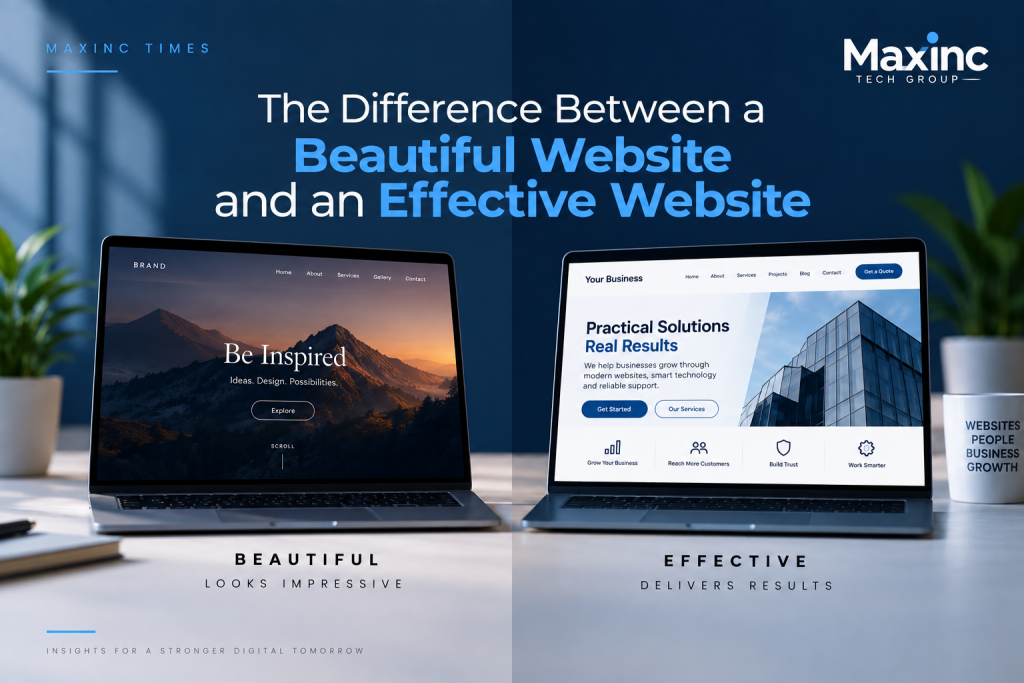
A website can look impressive and still fail to achieve what a business needs.
It can have stunning images, modern animations, elegant typography, and a visually attractive layout. Yet if visitors cannot understand what the business does, find the information they need, navigate the site easily, or take the next step, the design has limited value.
This is the difference between a beautiful website and an effective website.
A beautiful website focuses heavily on appearance. An effective website combines appearance with usability, performance, clear communication, and business objectives.
The two are not opposites. In fact, the strongest business websites are both beautiful and effective.
What Makes a Website Beautiful?
A beautiful website creates a strong visual impression.
It may use:
- Attractive colour combinations
- High-quality images
- Modern typography
- Creative layouts
- Smooth animations
- Visual effects
- Spacious sections
- Professional graphics
These elements can make a website enjoyable to look at and can contribute to a strong first impression.
Visual design matters because visitors form opinions about a business from what they see online.
However, appearance is only one part of the experience.
A website can look impressive and still leave visitors wondering:
What does this company actually do?
Where can I find its services?
How do I contact them?
What should I do next?
That is where effectiveness becomes important.
What Makes a Website Effective?
An effective website is designed around the needs of its users and the objectives of the business.
Instead of asking only, “Does this look good?”, an effective website also asks:
“Does this help the visitor accomplish something?”
That could mean helping someone understand a service, request a quotation, make a purchase, book an appointment, read an article, or contact the business.
Effectiveness therefore involves several elements working together.
1. Clear Communication
Visitors should quickly understand what the business offers.
A website homepage should communicate its main message without forcing people to dig through several pages.
Clear headings, concise descriptions, relevant visuals, and logical page structures help visitors understand the business faster.
A visually impressive homepage with an unclear message is still a communication problem.
2. Easy Navigation
A beautiful website becomes frustrating when visitors cannot find their way around it.
Navigation should be logical and predictable.
Important pages should be easy to locate, while related information should be grouped sensibly.
For example, a business might organise its website around:
About → Services → Projects → Blog → Contact
The exact structure will depend on the business, but visitors should not have to guess where information is located.
Good navigation makes the website feel simple to use.
3. Clear Calls to Action
An effective website guides visitors toward the next step.
A visitor might need to:
- Contact the business
- Request a quotation
- Book a service
- Purchase a product
- Call the company
- Send an enquiry
- Download information
Clear calls to action make these options obvious.
A website that provides information without giving visitors a clear path forward may generate interest without generating meaningful action.
4. Mobile Responsiveness
A website should work properly across different screen sizes.
Visitors may access the same website using a desktop computer, tablet, smartphone, or another device.
An effective responsive design adapts to those environments.
Text should remain readable, buttons should be easy to tap, images should scale properly, and navigation should remain usable.
A website that looks beautiful on a desktop but becomes difficult to use on a smartphone is not delivering a complete user experience.
5. Speed and Performance
Visual quality should not come at the expense of performance.
Large images, unnecessary animations, excessive scripts, and poorly optimized resources can slow down a website.
An effective website considers performance during development rather than treating it as an afterthought.
Images can be optimized, unnecessary resources reduced, and the underlying implementation structured efficiently.
The goal is simple:
Give visitors the visual experience they need without making them wait unnecessarily.
6. Content That Serves a Purpose
Effective websites do not publish content simply because a page needs to be filled.
Every major section should have a purpose.
A service page should explain the service.
An About page should establish context and credibility.
A contact page should make communication easy.
A blog should provide useful information.
Good content answers the questions visitors are likely to have.
This is particularly important for business websites because visitors are often trying to make a decision.
The website should provide enough relevant information to help them make that decision.
7. Trust and Credibility
An effective website should make visitors feel confident about the business.
This can be supported through genuine:
- Client testimonials
- Case studies
- Portfolio projects
- Company information
- Contact details
- Professional credentials
- Reviews
- Business location
- Team information
Trust does not come from design alone.
A polished website combined with useful information and credible evidence creates a stronger digital presence.
Beautiful vs Effective: What Is the Difference?
Consider two hypothetical websites.
Website A has impressive animations, large images, stylish typography, and an elaborate homepage.
However, its services are difficult to find, the contact button is buried, the pages load slowly, and the mobile version is difficult to navigate.
Website B has a clean and attractive design, but its primary focus is helping visitors understand the business. Services are clearly presented, navigation is simple, pages load efficiently, the website works well on mobile devices, and calls to action are easy to find.
Website A may create a stronger visual impression.
Website B is designed to accomplish more.
That distinction is important.
A Beautiful Website Should Still Be Effective
This does not mean businesses should ignore visual design.
Good aesthetics can strengthen credibility, communicate brand identity, and make a website more enjoyable to use.
The problem occurs when appearance becomes the primary objective.
Animations should support the experience rather than distract from the content.
Images should communicate something rather than simply occupy space.
Design elements should make information easier to understand rather than harder to find.
In other words:
Design should serve the user.
The Best Websites Combine Both
The goal should not be to choose between beauty and effectiveness.
A strong business website combines the two.
It can have:
Good visual design + clear content + simple navigation + responsive layouts + fast performance + strong calls to action + credible information.
When these elements work together, the website becomes more than a digital brochure.
It becomes a useful business tool.
Before Asking “Does My Website Look Good?”
The next time you evaluate your business website, do not stop at its appearance.
Ask:
- Can a new visitor understand what we do within a few seconds?
- Can people easily find our services?
- Does the website work properly on mobile devices?
- Are important pages easy to navigate?
- Do visitors know what to do next?
- Does the website load efficiently?
- Does the content answer customer questions?
- Does the website communicate trust?
- Does the design reflect our actual brand?
- Is the website helping us achieve our business objectives?
These questions reveal much more than visual appearance alone.
Final Thoughts
A beautiful website can attract attention.
An effective website uses that attention to create a useful experience.
For businesses, the goal should be more than creating something that looks impressive. A website should communicate clearly, guide visitors, build trust, perform efficiently, and make it easier for people to interact with the business.
Beauty gets attention. Effectiveness gives that attention a purpose.
The strongest business websites understand both.